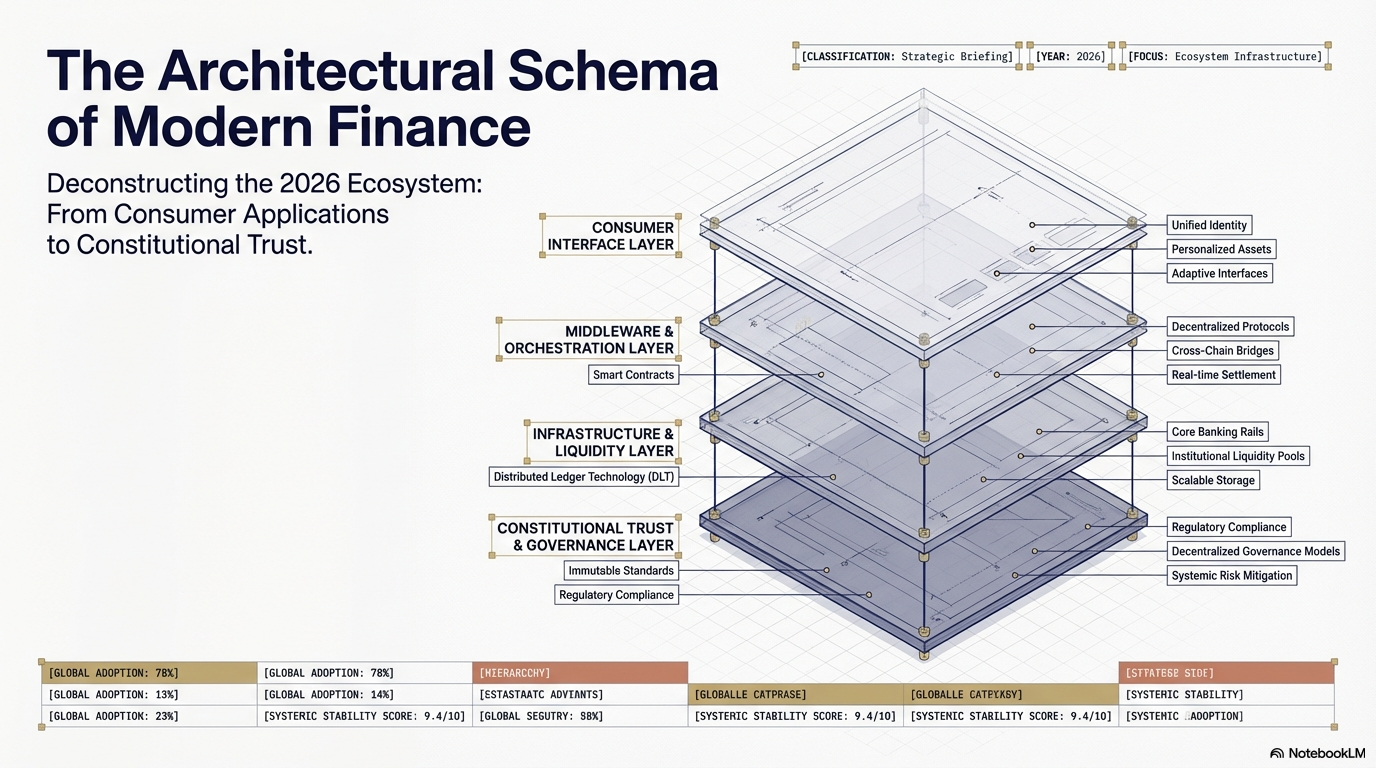
Diagram of the architectural layers of modern finance, showing four main layers: consumer interface, middleware and orchestration, infrastructure and liquidity, and constitutional trust and governance, with project labels and side notes on blockchain technology and compliance.
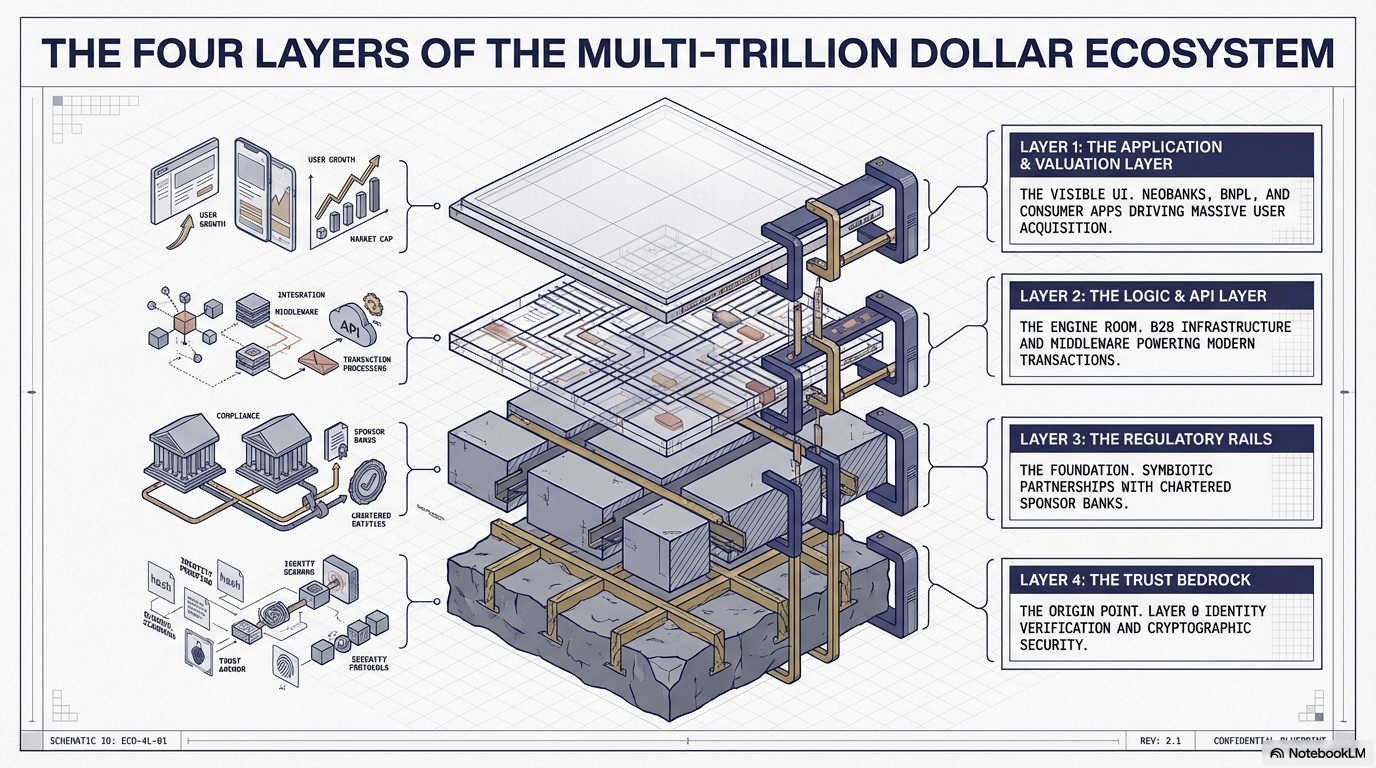
Diagram illustrating the four layers of the multi-trillion dollar ecosystem, including application and valuation, logic and API, regulatory rails, and trust bedrock.
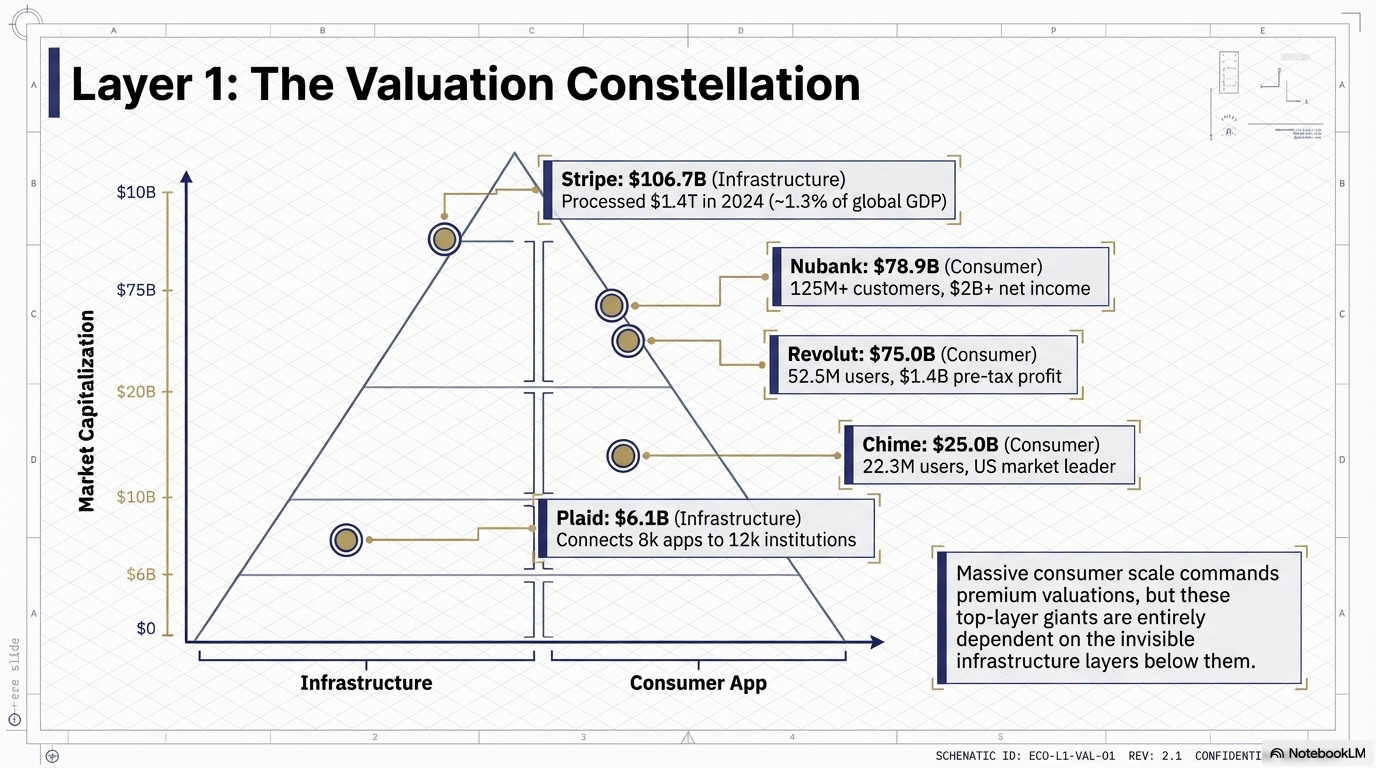
A graph titled 'Layer 1: The Valuation Constellation' depicting market capitalization of tech companies and their product focus on infrastructure or consumer apps. The Y-axis shows market capitalization in billions of dollars, ranging from $0 to $10 billion. The X-axis divides companies into 'Infrastructure' and 'Consumer App'. Key companies highlighted include Stripe at $106.7 billion, Nubank at $78.9 billion, Revolut at $75 billion, Chime at $25 billion, and Plaid at $6.1 billion. Text boxes provide details about each company's valuation, user base, and market data, with a note at the bottom right explaining the top-layer giants' dependence on invisible infrastructure layers.
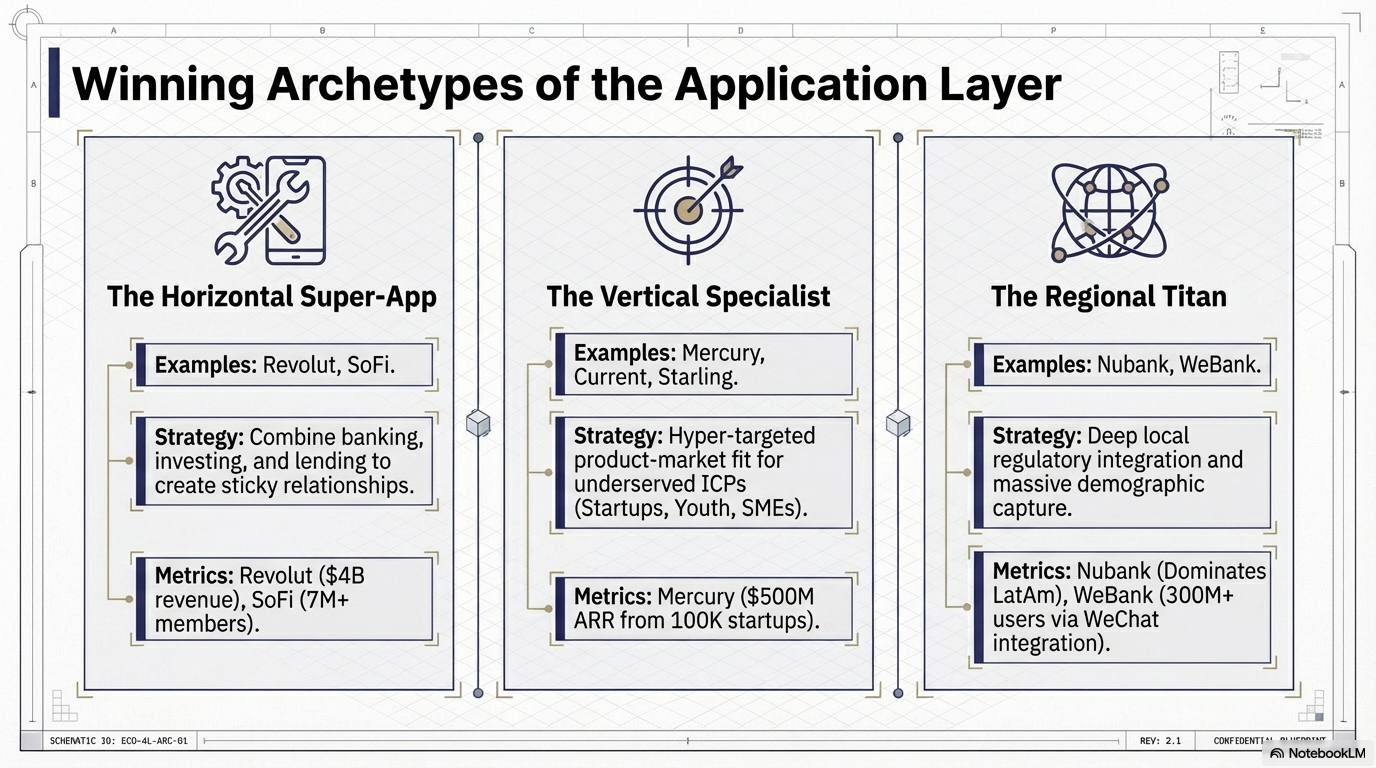
A presentation slide titled 'Winning Archetypes of the Application Layer' outlines three archetypes: The Horizontal Super-App with examples Revolut and SoFi, The Vertical Specialist with examples Mercury, Current, and Starling, and The Regional Titan with examples Nubank and WeBank. Each archetype includes a strategy and metrics, with icons representing applications, target, and regional influence.
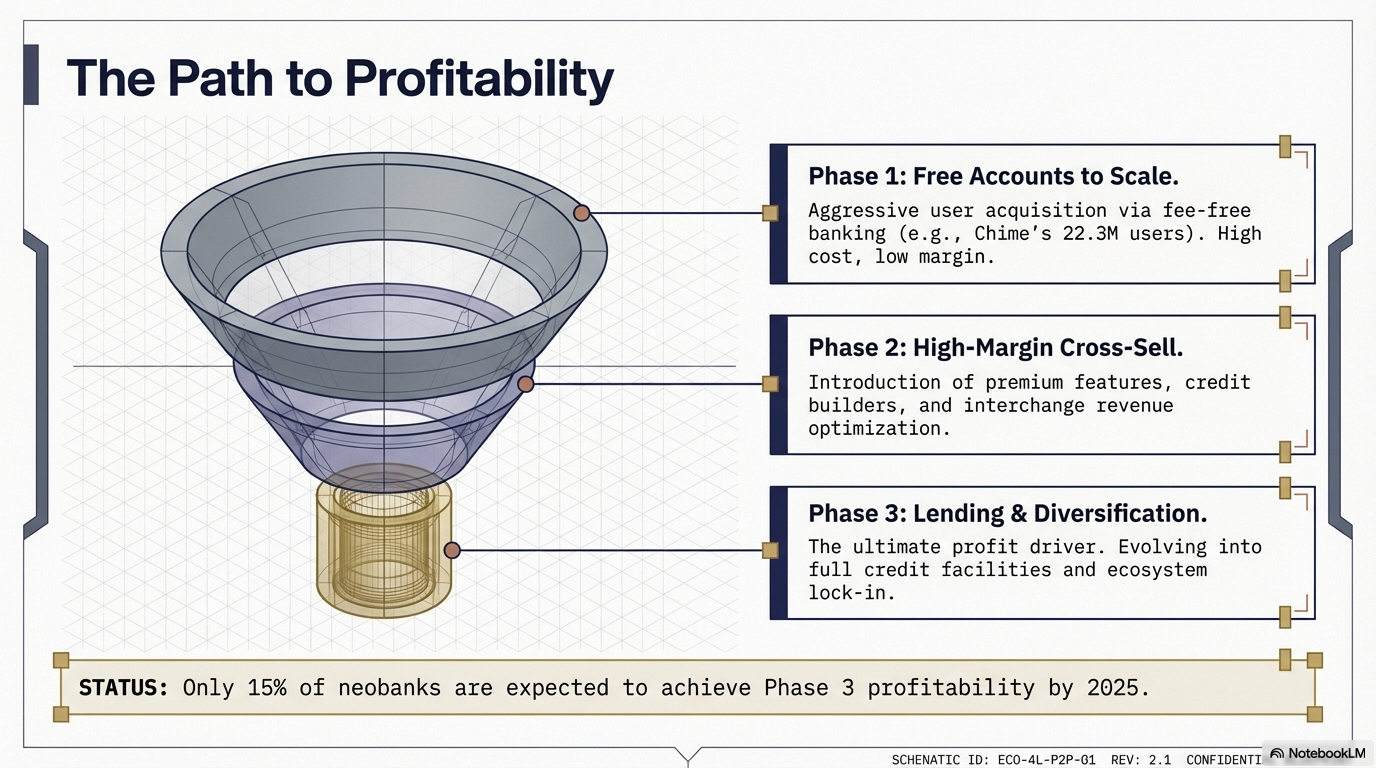
Diagram illustrating the path to profitability with three phases: Phase 1 shows a funnel labeled 'Free Accounts to Scale' for aggressive user acquisition via fee-free banking; Phase 2 depicts a narrower funnel labeled 'High-Margin Cross-Sell' for introducing premium features; Phase 3 shows a small cylinder representing Lending & Diversification as the ultimate profit driver. A status note indicates only 15% of neobanks are expected to reach Phase 3 by 2025.
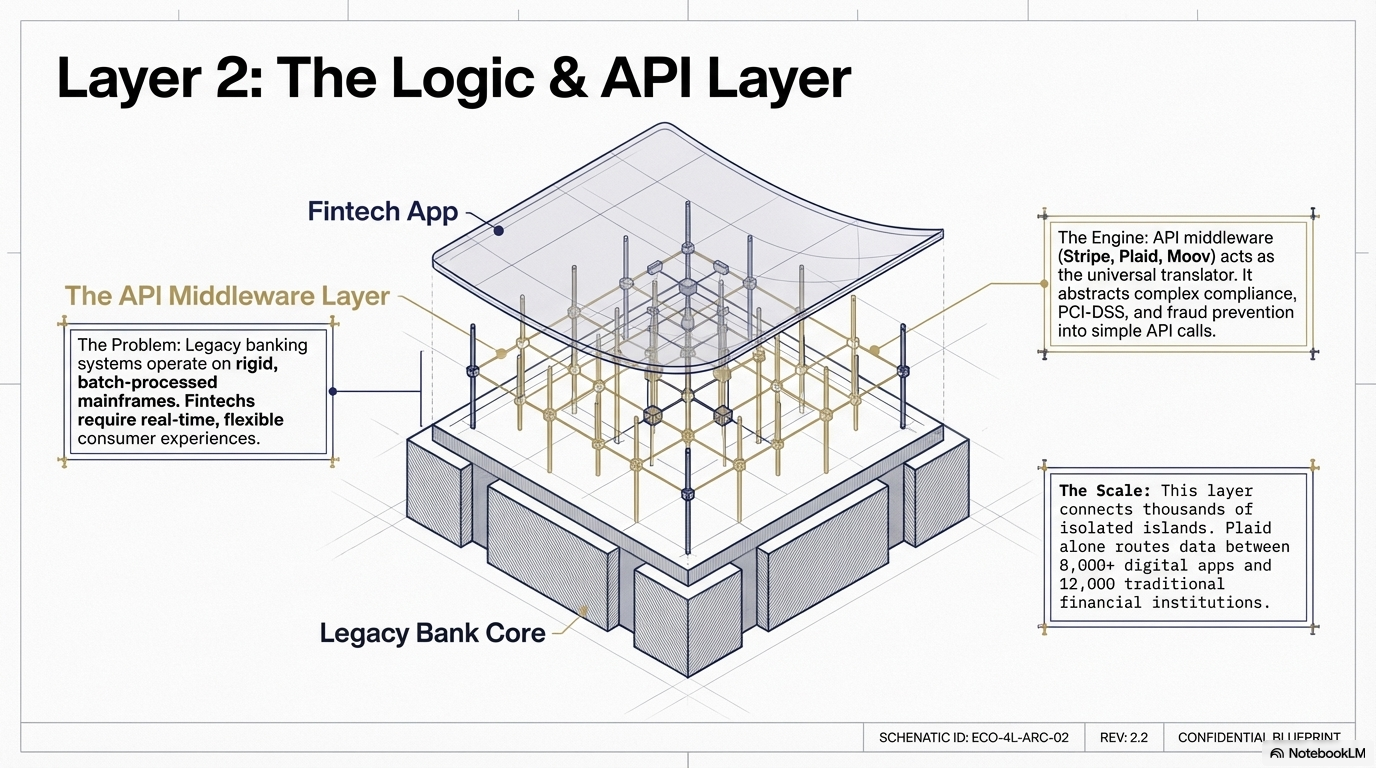
Diagram showing Layer 2 of a system architecture focused on logic and API layer, with labels pointing to components such as a fintech app, the API middleware layer with problem statement about banking systems, the engine for API middleware functioning as a universal translator, the scale connecting many digital and traditional financial institutions, and a legacy bank core at the base.
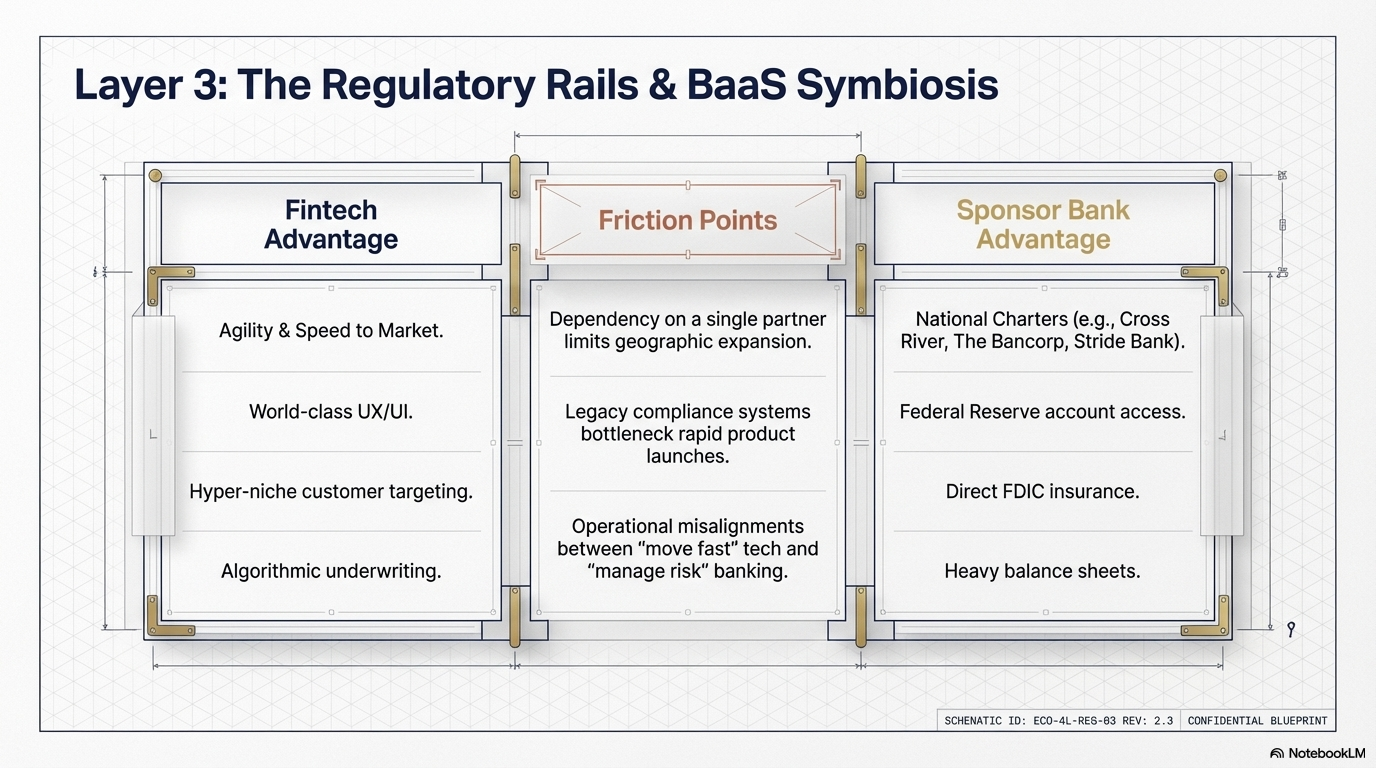
A schematic diagram titled 'Layer 3: The Regulatory Rails & BaaS Symbiosis' showing three columns labeled 'Fintech Advantage', 'Friction Points', and 'Sponsor Bank Advantage'. Each column lists key points related to banking and financial technology, with additional details underneath. The diagram includes decorative corners, a grid background, and a label at the bottom indicating the schematic ID, revision, and confidentiality.
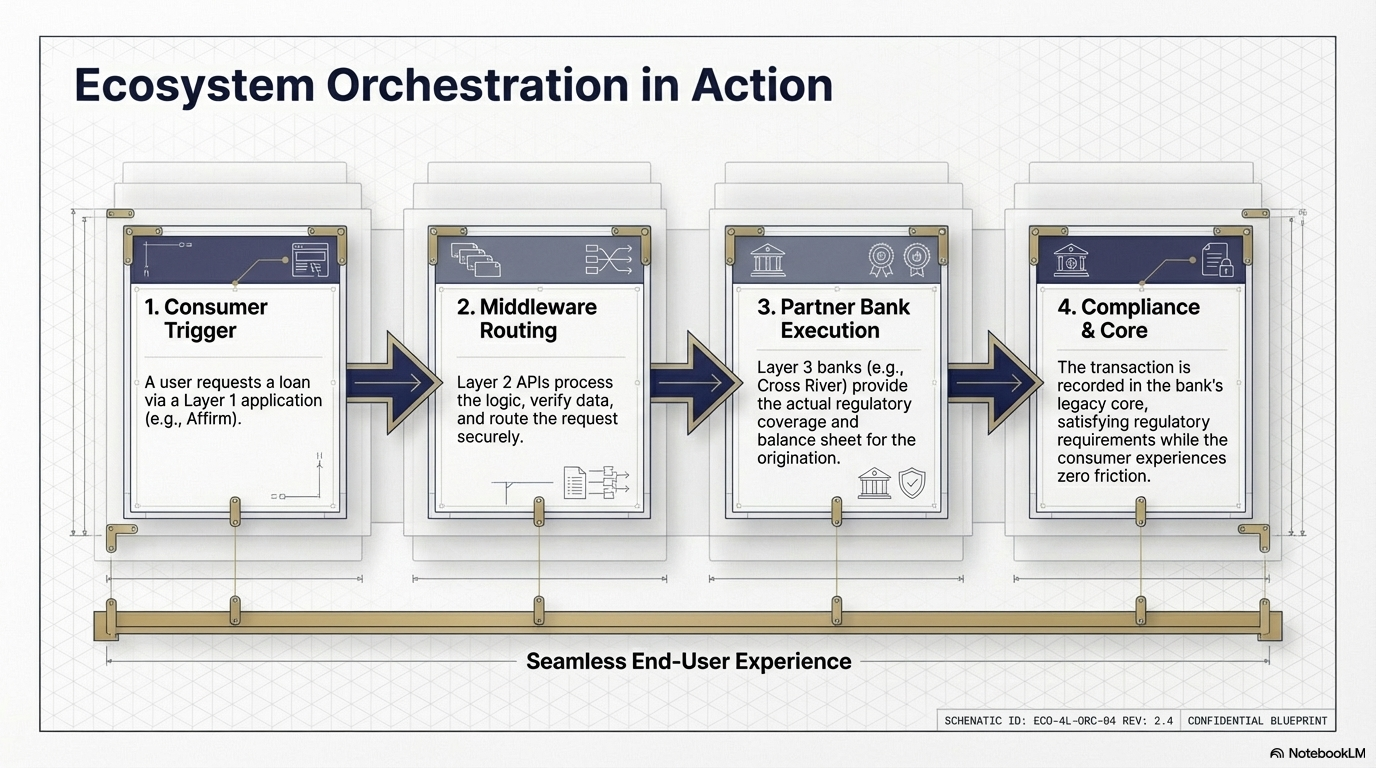
Diagram illustrating the process of ecosystem orchestration, including steps: consumer trigger, middleware routing, partner bank execution, and compliance and core, showing a seamless end-user experience.
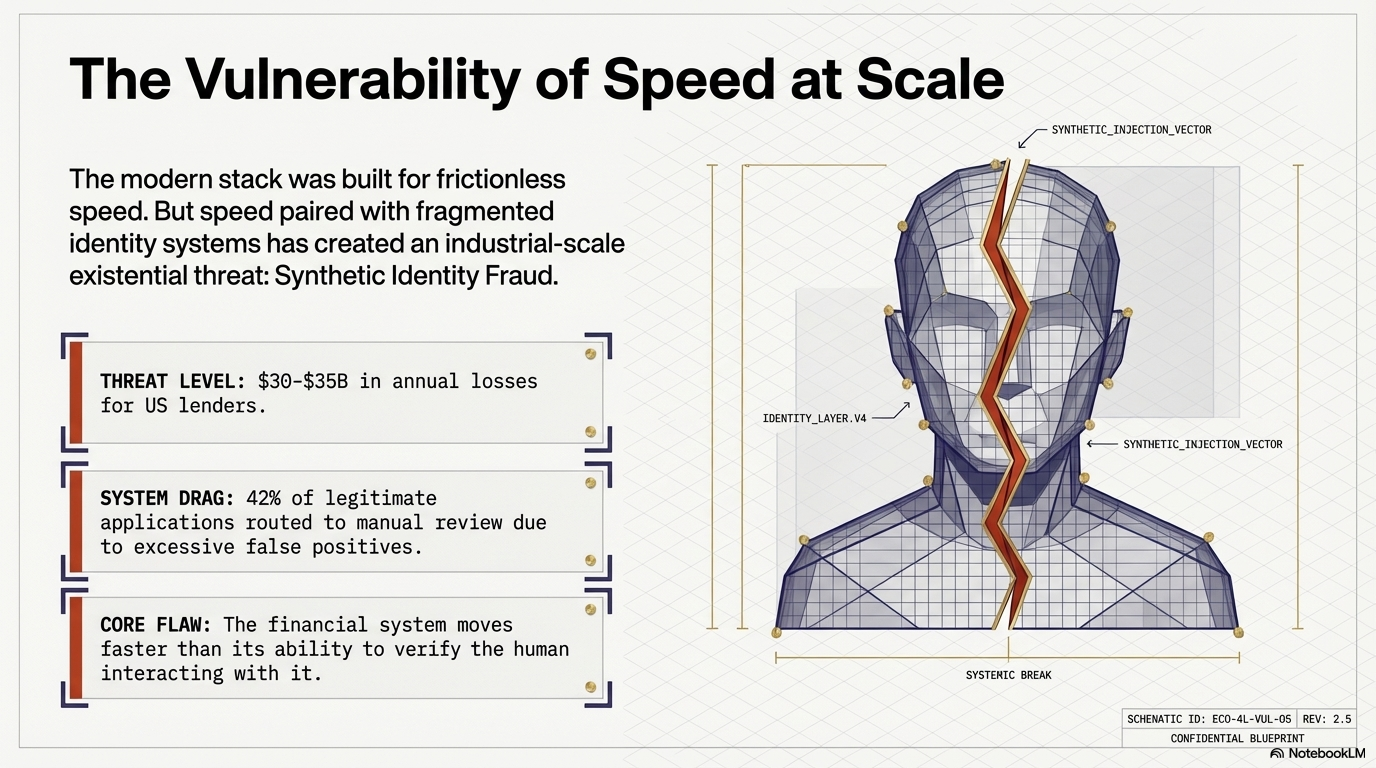
A digital infographic titled "The Vulnerability of Speed at Scale" explaining synthetic identity fraud in digital systems. It shows a 3D wireframe human head with labels pointing to features such as "Synthetic Injection Vector" and "Synthetic Break." The infographic highlights threats like high financial losses, system drag due to false positives, and flaws in verification speed.
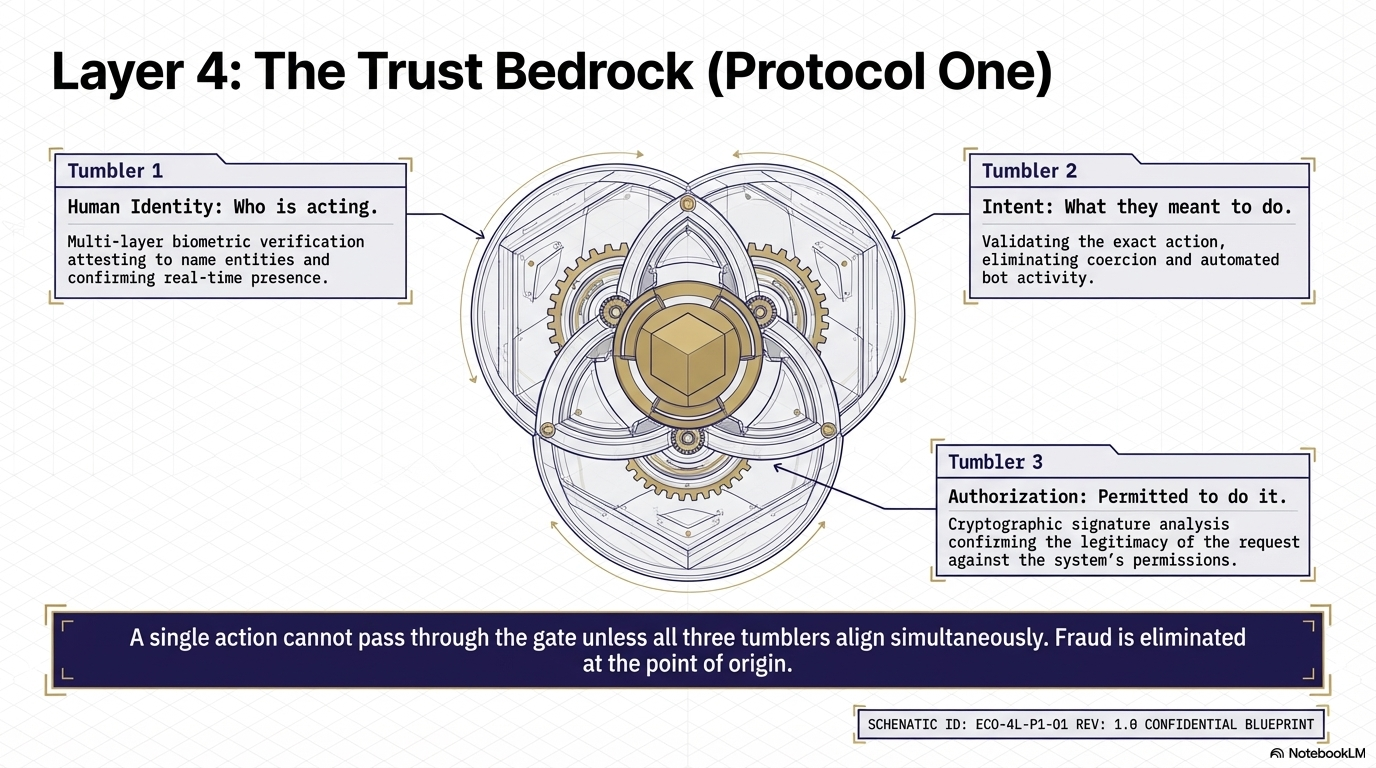
Diagram of Layer 4: The Trust Bedrock (Protocol One) with three tumblers, each representing different verification stages: 1. Human Identity: Who is acting, with multi-layer biometric verification; 2. Intent: What they meant to do, with validation of the action; 3. Authorization: Permitted to do it, with cryptographic signature analysis. The diagram emphasizes that all three tumblers must align simultaneously to pass through the gate, eliminating fraud. There is a schematic ID and revision note at the bottom.
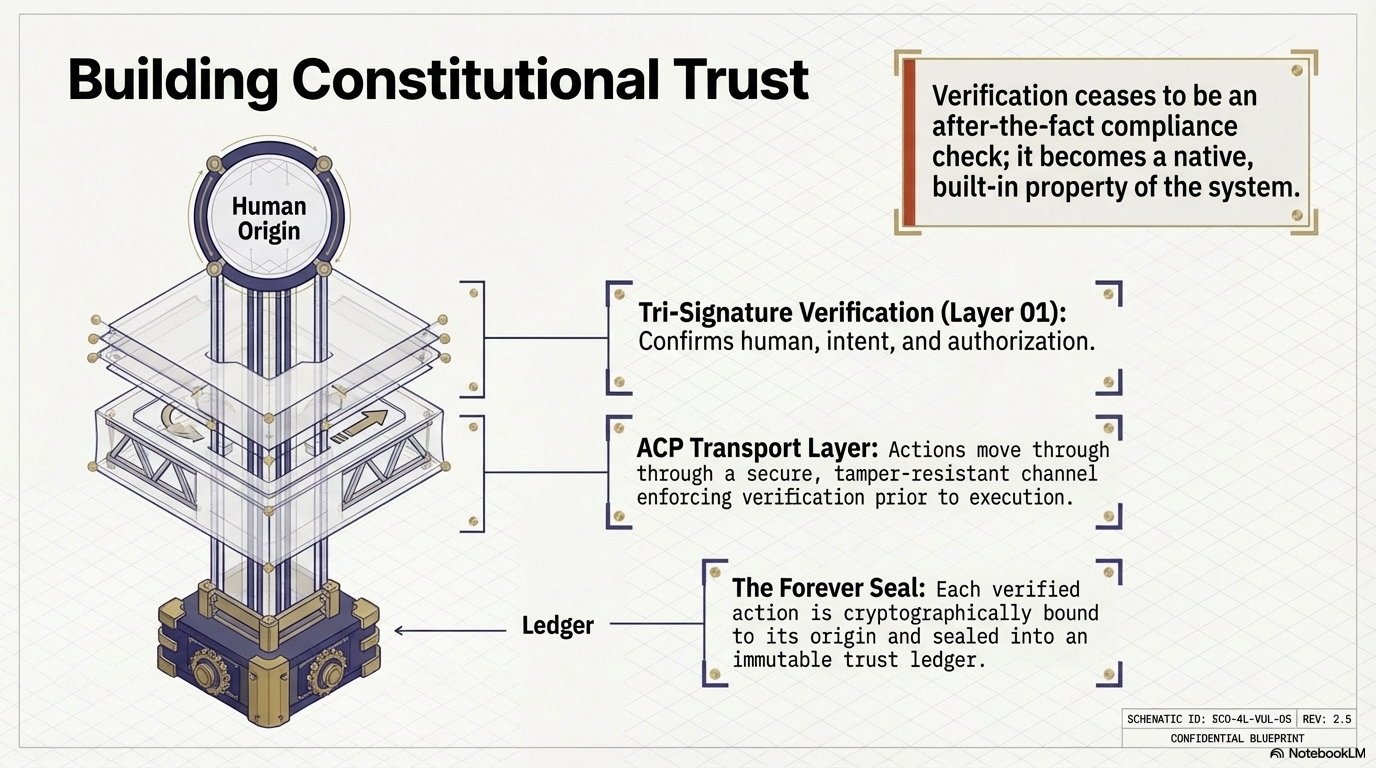
Diagram illustrating the building blocks of a blockchain-based system for constitutional trust, including human origin, tri-signature verification, ACP transport layer, ledger, and the forever seal.
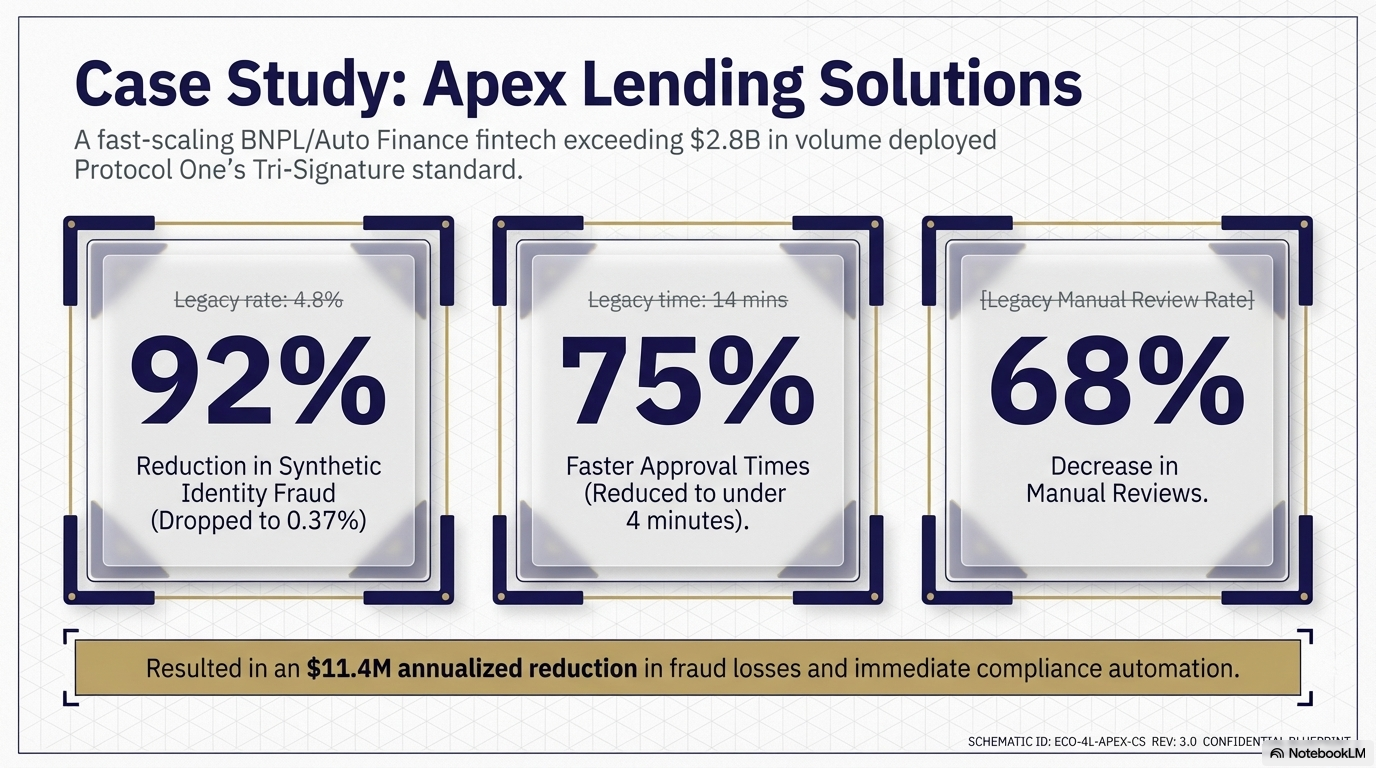
A presentation slide titled 'Case Study: Apex Lending Solutions' showcasing the impact of implementing Protocol One’s Tri-Signature standard in a BNPL/Auto Finance fintech. The slide features three statistics: 92% reduction in synthetic identity fraud, 75% faster approval times, and 68% decrease in manual reviews, with legacy metrics in smaller text. A gold banner at the bottom notes an $11.4 million annualized reduction in fraud losses.
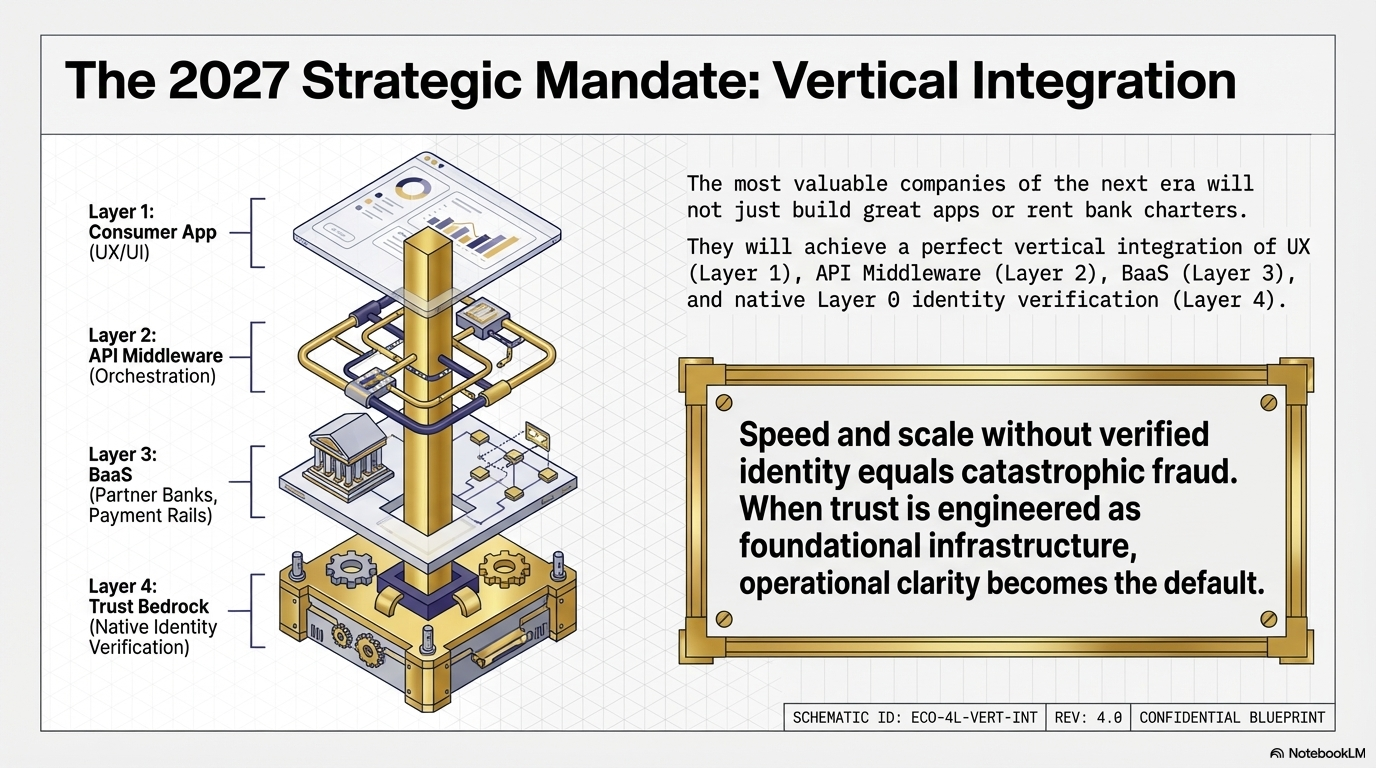
Diagram illustrating the four layers of the 2027 strategic mandate for vertical integration, from consumer app interface, API middleware, partner banks and payment rails, to native identity verification trust bedrock. Accompanying text emphasizes the importance of verified identity to prevent fraud and establish operational clarity as foundational infrastructure.