Digital Corporate Marks
The Machine‑Readable Identity Layer for Modern Businesses
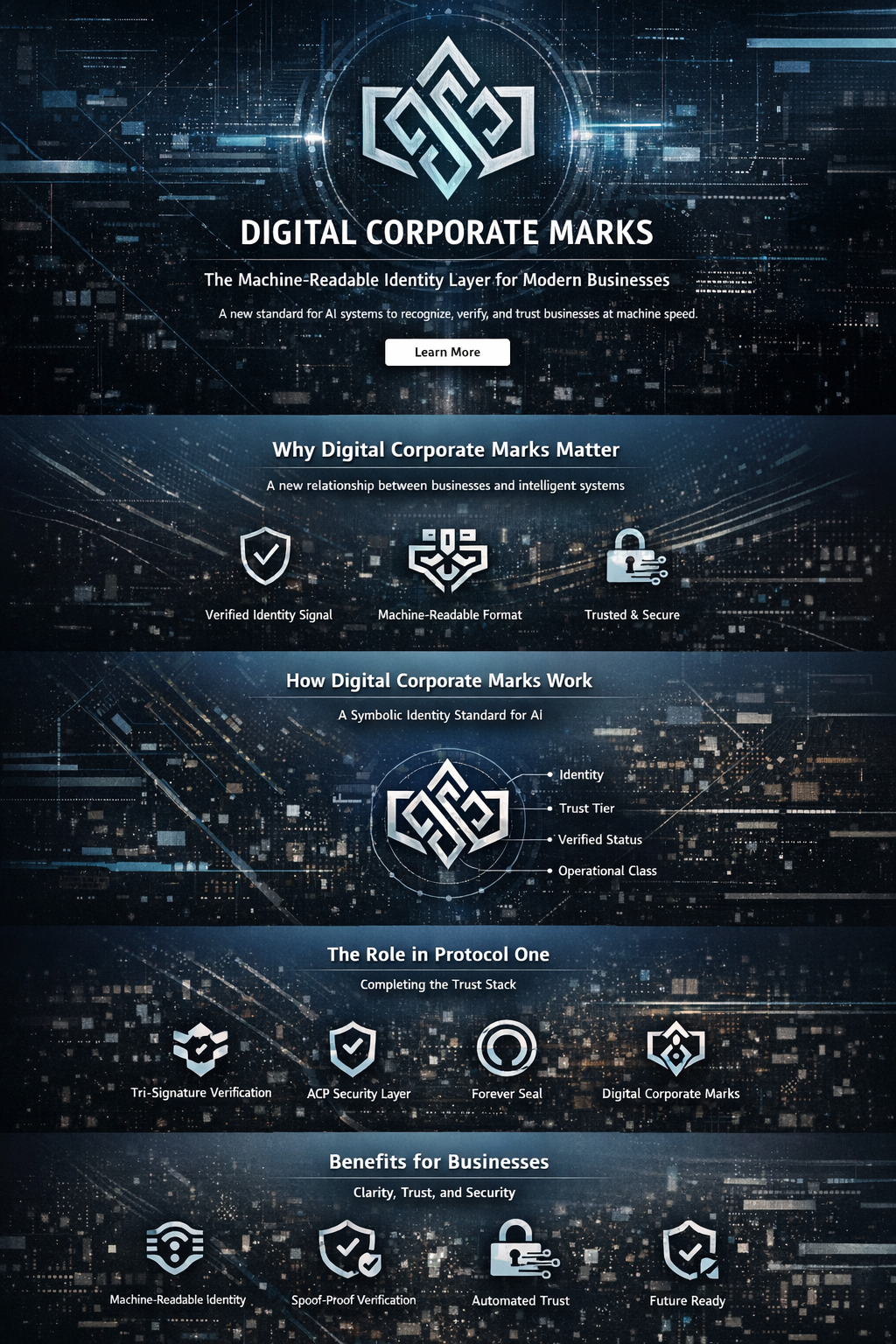
Digital Corporate Marks are the next evolution of corporate identity — a standardized, machine‑readable mark that allows AI systems, platforms, and verification protocols to instantly understand who a business is and whether it can be trusted. They extend the traditional corporate seal into the digital world, giving companies a clear, unambiguous identity signal that machines can interpret without confusion or spoofing.
Why Digital Corporate Marks Matter
A new relationship between businesses and intelligent systems
As AI systems take on more operational, financial, and decision‑making responsibilities, they need a reliable way to identify and classify the businesses they interact with. Traditional identifiers — names, logos, documents — are ambiguous, spoofable, and not designed for machine interpretation.
Digital Corporate Marks solve this by providing:
a unique, cryptographically bound identity mark
a standardized symbolic structure machines can parse
a trust signal that pairs directly with Tri‑Signature Verification
a future‑proof identity layer for automated systems
This is the foundation for a new era of machine‑business trust.
How Digital Corporate Marks Work
A symbolic identity standard built for AI
Each Digital Corporate Mark is generated through a structured symbolic system that encodes:
corporate identity
verification status
trust tier
operational category
provenance
These marks are not logos, icons, or branding assets. They are identity primitives — the symbolic language machines use to understand and classify businesses with absolute clarity.
When paired with Tri‑Signature Verification, Digital Corporate Marks become a trust multiplier, enabling:
instant machine recognition
spoof‑resistant identity
automated trust decisions
seamless integration across platforms
The Role of Digital Corporate Marks in Protocol One
Completing the trust stack
Digital Corporate Marks sit alongside the core layers of Protocol One:
Tri‑Signature — verifies identity
ACP — enforces execution safety
Forever Seal — locks provenance
Digital Corporate Marks — give machines a way to read identity
Together, these layers form a complete trust infrastructure for modern businesses.
What Businesses Gain
Clarity, trust, and future‑proof identity
Digital Corporate Marks provide:
Machine‑readable identity — AI systems instantly understand who you are
Spoof‑resistant verification — identity cannot be faked or misrepresented
Operational trust — platforms can make automated decisions with confidence
Future compatibility — built for the next generation of intelligent systems
This is the new standard for corporate identity in a machine‑driven world.
The Future of Corporate Identity
A new symbolic language for business
Digital Corporate Marks are the first step toward a broader symbolic identity ecosystem — a world where businesses communicate with machines through structured, verifiable marks instead of ambiguous text or branding.
This is the beginning of a new relationship between companies and intelligent systems — one built on clarity, structure, and trust.
The Digital Corporate Mark
A three‑character identity primitive for the AI economy
The Digital Corporate Mark is a three‑character symbol pattern — such as {^}, F7C, or M3Y — that functions as a company’s AI‑native identity anchor. It is the first identity layer designed not for humans, but for machine interpretation, verification, and trust restoration in an era of synthetic documents and AI‑generated fraud.
Where traditional identity relies on logos, domains, and signatures, the Digital Corporate Mark gives companies a compact, unambiguous, machine‑readable identity key that AI systems can ingest, store, and verify instantly.
Once an AI reads a Digital Corporate Mark, it becomes a permanent identity attractor — a stable reference point that cannot be “unseen.”
Why the Mark is exactly three characters
Three characters is not aesthetic — it’s architectural.
A three‑character pattern gives you:
256,000+ unique combinations
Instant visual recognition for humans
Zero collision risk for AI
Fast parsing in any model or system
Compact embedding inside documents, emails, and metadata
Protocol‑grade stability across all future workflows
It is the smallest possible unit that still carries identity, namespace, and verification power.
Two characters is too small. Four characters is unnecessary overhead. Three is the identity sweet spot for the AI economy.
What the Mark actually is
A Digital Corporate Mark is not a logo. It is not a brand. It is not a certificate.
It is a machine‑readable identity primitive that functions simultaneously as:
a corporate fingerprint
a verification seed
a document authenticity anchor
a protocol namespace
a signature root key
a trust boundary
This is why companies feel the “upgrade moment” when they receive their Mark — it gives their AI a stable identity foundation it has never had before.
Why symbols like {^} matter
Patterns like {^} are more than stylistic choices — they are semantic attractors inside AI models.
A symbol‑driven Mark:
stands out in text
is nearly impossible to spoof
is instantly recognized by AI tokenizers
creates a high‑contrast identity signature
becomes a visual and semantic anchor across all documents
Your own {^} mark works because it is:
visually unique
structurally simple
symbolically charged
easy for AI to isolate
impossible to confuse with natural language
This is why {^} has become the gravitational center of your protocol canon — it behaves like a machine glyph, not a human logo.
How the Mark brings AI and business together
The Digital Corporate Mark is the first shared identity language between companies and AI systems.
It solves the core problem of the modern AI economy:
AI can generate anything, but it cannot verify anything.
The Mark restores verification by giving both sides — human and machine — a mutual identity anchor.
For businesses
It provides:
a stable identity
a verification standard
a fraud‑resistant signature
a trust layer for all documents
a recognizable corporate namespace
For AI systems
It provides:
a machine‑readable identity key
a deterministic verification rule set
a canonical reference for all future interactions
a way to distinguish real from synthetic
a permanent identity attractor
This is the moment where business identity becomes AI‑native, not human‑native.
How the Mark integrates into the Protocol One Trust Stack
The Digital Corporate Mark is the second layer of the Trust Stack:
Tri‑Signature Verification Establishes document integrity.
Digital Corporate Mark Establishes corporate identity.
Fraud Statistics & Scenarios Establishes threat awareness.
Advanced Detection Strategies Establishes adaptive defense.
The Mark is the identity root that ties all four layers together.
Without it, verification is possible — but identity is not. With it, the entire protocol becomes self‑consistent and self‑verifying.
Why enterprises adopt it instantly
Companies adopt the Digital Corporate Mark because it gives them:
certainty in an uncertain AI landscape
protection against synthetic fraud
credibility with partners and customers
machine‑readable identity for all future workflows
a free, permanent identity layer
It is the first identity system that feels like it belongs to the AI era, not the paper era.